09 novembre 2026
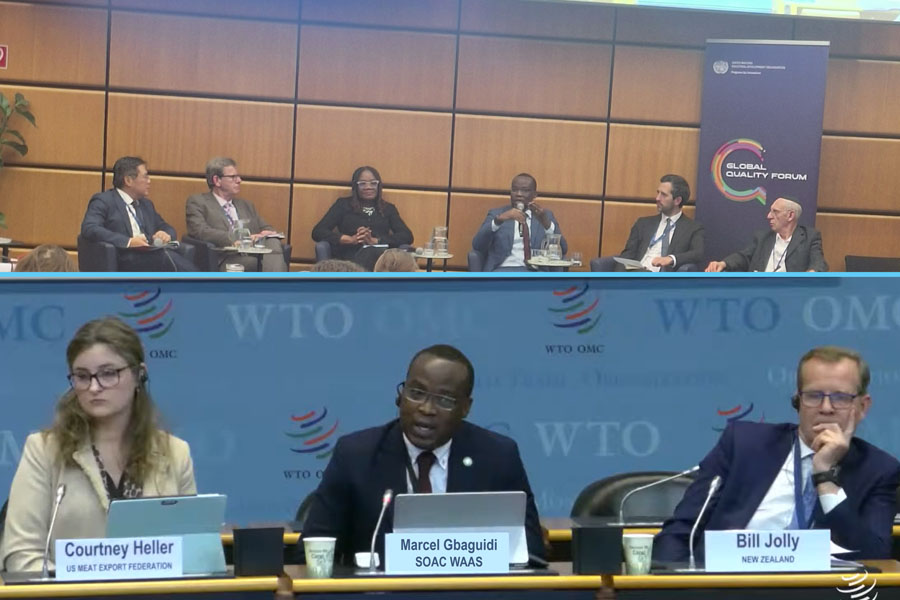
Geneva / Vienna – Early November 2026 — During major international meetings held successively at the World Trade Organization (WTO) headquarters in Geneva and at the United Nations Industrial Development Organization (UNIDO) World Quality Forum in Vienna, the West African Accreditation System (SOAC) reaffirmed the strategic role of accreditation as a catalyst for sanitary and phytosanitary trust, regional economic integration, and trade facilitation.
Representing SOAC, Director General Marcel Gbaguidi shared the West African experience across two complementary areas: the technical strengthening of Sanitary and Phytosanitary (SPS) controls and the cost-effectiveness of regional quality infrastructure pooling.
Geneva (WTO): Securing the Chain of Custody, from Sampling to Testing
At the thematic sessions of the WTO SPS Committee (3 November 2026), discussions highlighted an often-critical link in control procedures: sampling.
While the technical competence of testing laboratories is increasingly demonstrated through accreditation against ISO/IEC 17025, the evidentiary value of test results depends directly on the representativeness and rigor of the initial sample collection. When sampling is conducted outside a rigorously assessed technical framework, the risk of border disputes, unjustified rejections, or false health assurances escalates significantly.
In this regard, SOAC recommended:
Vienna (UNIDO): Economic and Technical Efficiency of Regional Pooling
At the UNIDO World Quality Forum (5 November 2026), SOAC’s Director General demonstrated the viability of a multi-country regional accreditation body model.
In contexts where establishing individual national accreditation bodies can prove disproportionate and cost-prohibitive for smaller domestic markets, SOAC’s operational experience yields concrete benefits:
The STDF PG 770 Project: Bridging SPS Authorities and Conformity Assessment
These two addresses align directly with the operational objectives of the STDF PG 770 Project, supported by the Standards and Trade Development Facility.
Covering the eight Member States of UEMOA along with Guinea, this project aims to:
About SOAC
The West African Accreditation System (SOAC) is the regional multi-economy accreditation body established by the West African Economic and Monetary Union (UEMOA). Internationally recognized, SOAC's mandate is to provide globally accepted accreditation services to conformity assessment bodies (testing and calibration laboratories, inspection bodies, certification bodies, etc.) operating within the UEMOA region and beyond.
Representing SOAC, Director General Marcel Gbaguidi shared the West African experience across two complementary areas: the technical strengthening of Sanitary and Phytosanitary (SPS) controls and the cost-effectiveness of regional quality infrastructure pooling.
Geneva (WTO): Securing the Chain of Custody, from Sampling to Testing
At the thematic sessions of the WTO SPS Committee (3 November 2026), discussions highlighted an often-critical link in control procedures: sampling.
While the technical competence of testing laboratories is increasingly demonstrated through accreditation against ISO/IEC 17025, the evidentiary value of test results depends directly on the representativeness and rigor of the initial sample collection. When sampling is conducted outside a rigorously assessed technical framework, the risk of border disputes, unjustified rejections, or false health assurances escalates significantly.
In this regard, SOAC recommended:
- Accrediting inspection bodies against ISO/IEC 17020, explicitly covering sampling procedures;
- Utilizing accreditation as an independent technical benchmark to support regulatory authorities in their official control mandates.
Vienna (UNIDO): Economic and Technical Efficiency of Regional Pooling
At the UNIDO World Quality Forum (5 November 2026), SOAC’s Director General demonstrated the viability of a multi-country regional accreditation body model.
In contexts where establishing individual national accreditation bodies can prove disproportionate and cost-prohibitive for smaller domestic markets, SOAC’s operational experience yields concrete benefits:
- Cost reduction: Accreditation access costs for UEMOA Member States have been reduced eightfold compared to relying individually on foreign accreditation bodies;
- International recognition: Streamlined access to multilateral recognition arrangements through AFRAC (African Accreditation Cooperation) and Global ACI (the merged entity of ILAC and IAF operational since January 2026);
- Operational proximity: Maintained local anchoring through the network of National Focal Points (NFPs), providing direct liaison with public administrations and economic operators without compromising the independence of accreditation decisions.
The STDF PG 770 Project: Bridging SPS Authorities and Conformity Assessment
These two addresses align directly with the operational objectives of the STDF PG 770 Project, supported by the Standards and Trade Development Facility.
Covering the eight Member States of UEMOA along with Guinea, this project aims to:
- Foster institutional and technical collaboration between SPS competent authorities and conformity assessment bodies (CABs);
- Harmonize and professionalize official inspection and sampling practices;
- Mitigate redundant testing, transaction costs, and border clearance delays through mutual trust founded on international accreditation.
About SOAC
The West African Accreditation System (SOAC) is the regional multi-economy accreditation body established by the West African Economic and Monetary Union (UEMOA). Internationally recognized, SOAC's mandate is to provide globally accepted accreditation services to conformity assessment bodies (testing and calibration laboratories, inspection bodies, certification bodies, etc.) operating within the UEMOA region and beyond.